
General information, not medical advice. Your midwife, health visitor or paediatrician knows your baby. This page is not for babies born early, babies who are not gaining weight, babies with a medical condition, or babies on a specialist formula: follow your care team’s plan.
Is there one right amount to pump?
No. It depends on whether you pump all of your baby’s milk or pump between breastfeeds, on how old your baby is and on how often you pump. The CDC gives no target in ounces. It says pumping helps your body make about the amount your baby needs, that this amount differs from baby to baby, and that you can try to pump as often as your baby drinks breast milk. KellyMom’s figures below are averages and ranges, not goals.
| Situation | mL | oz |
|---|---|---|
| Daily output to aim for by days 7–10, pumping instead of breastfeeding | 750–800 mL a day | 25–27 oz a day |
| Baby’s daily breast milk intake, 1–6 months (average) | 750 mL a day | 25 oz a day |
| Baby’s daily breast milk intake, 1–6 months (typical range) | 570–900 mL a day | 19–30 oz a day |
| Breast milk at 7 months, alongside solids (one study) | about 875 mL a day | about 30 oz a day |
| Breast milk at 11–16 months (one study) | about 550 mL a day | about 19 oz a day |
| Per bottle, at 8 feeds a day (25 oz ÷ 8) | (about 90 mL) | about 3 oz |
| Per session, pumping between breastfeeds | (about 30–90 mL) | 1–3 oz |
| Per session, breastfeeding full-time | (about 15–60 mL) | ½–2 oz |
How much should I pump per day?
If you pump instead of breastfeeding, KellyMom’s page on establishing supply when baby is not breastfeeding suggests aiming for 750–800 mL (25–27 oz) a day by 7–10 days after birth. That matches what babies drink: KellyMom’s expressed milk calculator page puts intake from 1 to 6 months at an average of 750 mL (25 oz) a day, within a typical range of 570–900 mL (19–30 oz).
For mothers pumping all of the baby’s milk, the same KellyMom page calls 350–500 mL (11–17 oz) at day 10 borderline and under 350 mL (11 oz) low. That is a reason to talk to a lactation consultant early, not a verdict on you. If you are pumping exclusively, our exclusive pumping schedule guide covers how sessions are spread across the day.
How much milk per pumping session is normal?
It depends on how the session fits around feeding. KellyMom’s What to Expect When Pumping says the average mother pumping between breastfeeds gets one to three ounces (about 30–90 mL) a session, for both breasts together, not each. Its page on not pumping enough milk gives a lower range for mothers who breastfeed full-time: about ½–2 oz (about 15–60 mL) total, and it calls 4 oz a rather large output for them.
That page also says it is not unusual to need two or three pumping sessions to collect one feed’s worth of milk, and that many mothers pump more per session when they are away from their baby or pump exclusively. So by KellyMom’s figures, a small amount right after the baby has fed is common, and what you pump is not the same as what your baby gets from the breast.
How do I work out how much to leave for one feed?
KellyMom’s method is simple: count your baby’s feeds in 24 hours and divide the daily average by that number. With 8 feeds, 25 oz ÷ 8 is about 3 oz (about 90 mL) a feed. With 10 feeds, each is smaller. Babies vary, and the CDC notes that breastfed babies feed about 8 to 12 times in 24 hours, so a range of bottle sizes is normal. If milk goes into the fridge or freezer for later, the CDC and NHS storage times differ, so check both.
Does the amount change as my baby gets older?
Less than many parents expect. KellyMom says daily breast milk intake stays at about 750 mL (25 oz) between 1 and 6 months, rather than climbing month by month. One study cited by KellyMom found about 875 mL (30 oz) a day at 7 months and about 550 mL (19 oz) at 11–16 months, as solid food takes a bigger share.
Output can still drop. KellyMom lists things that can lower what you pump, including worn pump parts or a flange that is too small for you (KellyMom says a larger flange helps some mothers), pumping less often, starting solids, hormonal birth control, a period, stress, illness and some medicines. It also says many mothers make more milk than the baby needs in the early weeks, and that this settles to the baby’s needs over the first few weeks or months, often around 6–12 weeks, which can look like a drop when it is not.
How often and how long should I pump?
To build supply when your baby is not breastfeeding, KellyMom suggests at least eight good nursing or pumping sessions in 24 hours, and calls ten better. For that same exclusive pumping, once milk is in, it suggests about 30 minutes a session, or 2–5 minutes after the last drops. For pumping between feeds, its What to Expect When Pumping page says most mothers need at least 10 minutes and no more than 20–30 minutes. The CDC suggests a lactation support provider for help making pumping work for you.
How can I tell if my baby is getting enough?
Look at the baby, not just the bottle. The AAP’s page on telling if a breastfed baby is getting enough milk says that by 5 to 7 days old a baby should have 6 or more wet diapers a day, with nearly colourless or pale yellow urine, and should lose no more than 8–10% of birth weight in the first few days before gaining again. Our guide to how many wet diapers a newborn should have goes into this in more detail.
How does Milkies help me track pumping?
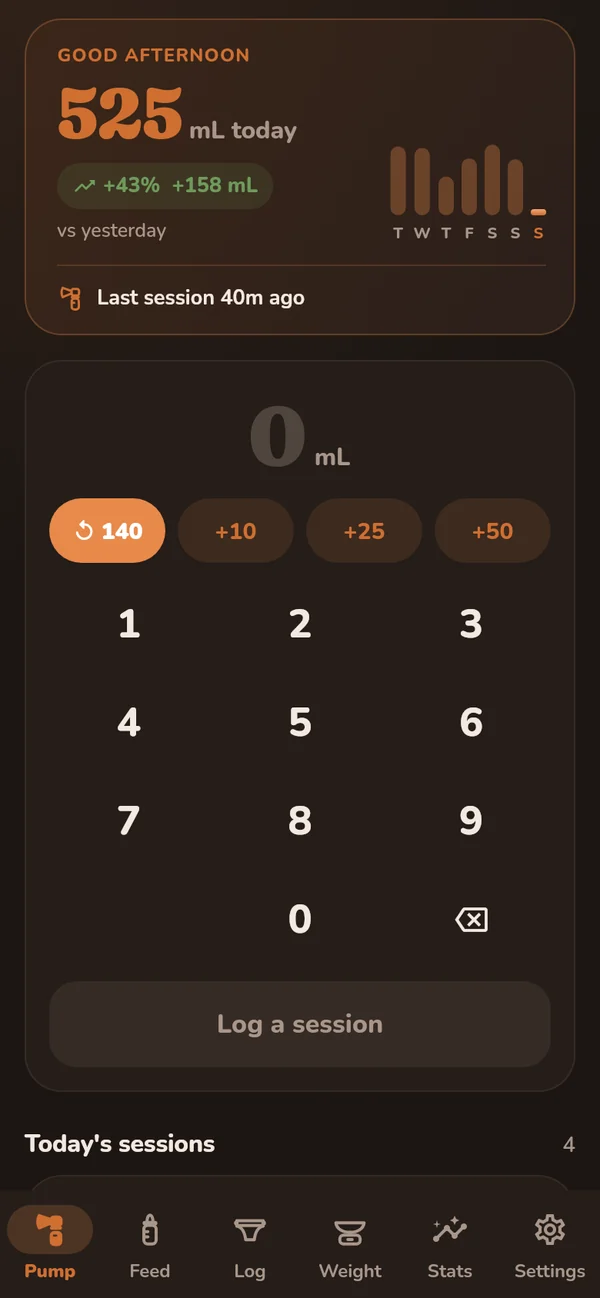
Milkies keeps pumping in its own log, apart from the bottles your baby drinks. Each session is an amount in mL and a time. The Pump tab shows today’s total, the change against yesterday in percent and mL, a seven-day bar strip, how long since the last session, and today’s sessions on a timeline. A “same as last time” button fills in your last amount in one tap, then you tap Log. In Stats, Pumping mode shows your daily average, biggest day and week, this week against last, a daily chart, your average session, your current streak and your busiest time. If you pair your partner’s phone, you both see the same log.
What Milkies doesn’t do: it has no pumping target or goal, no left or right breast, no session timer or length, no reminders, no freezer stash count, and no ounce entry. It records what you pump; it does not judge whether that is enough.
Milkies adds up every pump session in mL and puts today next to yesterday and the last seven days. Free, no account, no ads.
Get MilkiesSources
- KellyMom: How much expressed milk will my baby need? (updated 22 August 2026)
- CDC: Pumping Breast Milk (dated 24 February 2026)
- KellyMom: Establishing and maintaining milk supply when baby is not breastfeeding (updated 22 August 2026)
- KellyMom: What to Expect When Pumping (updated 22 August 2026)
- KellyMom: I’m not pumping enough milk. What can I do? (updated 22 August 2026)
- CDC: How Much and How Often to Breastfeed (dated 16 April 2026)
- AAP (HealthyChildren.org): How to Tell if Your Breastfed Baby is Getting Enough Milk (updated 13 January 2025)
- AAP (HealthyChildren.org): Warning Signs of Breastfeeding Problems (updated 25 March 2024)
Sources checked as of .