
General information, not medical advice. Your midwife, health visitor or paediatrician knows your baby. This page is not for babies born early, babies who are not gaining weight, babies with a medical condition, or babies on a specialist formula: follow your care team’s plan.
How long does breast milk last?
It depends on where the milk is kept, how cold that place is, and which health body you follow. The US CDC gives freshly expressed milk up to 4 hours at room temperature, 4 days in the fridge and about 6 months in the freezer (up to 12 months acceptable). The UK NHS gives up to 8 days in a fridge at 4 °C or lower and up to 6 months in a freezer at −18 °C or lower. Both say never refreeze thawed milk. They differ most on the fridge, thawed milk and leftovers.
| Where or what | CDC (US) | NHS (UK) |
|---|---|---|
| Room temperature, freshly expressed | Up to 4 hours at 25 °C (77 °F) or colder | No time given on this page |
| Fridge | Up to 4 days | Up to 8 days at the back, at 4 °C (39 °F) or lower; within 3 days if 5–10 °C (41–50 °F) or unsure |
| Ice compartment inside a fridge | Not listed separately | 2 weeks |
| Freezer | About 6 months best; up to 12 months acceptable | Up to 6 months at −18 °C (0 °F) or lower |
| Cool bag with ice packs | Up to 24 hours (insulated cooler with frozen ice packs, when travelling) | Up to 24 hours (milk already cooled in the fridge) |
| Thawed in the fridge | Use within 24 hours of fully thawing | Use straight away once defrosted |
| Brought to room temperature or warmed | Use within 2 hours | Use straight away |
| Leftover after the baby drank from the bottle | Use within 2 hours, then discard | Use within 1 hour, then throw away |
| Refreeze thawed milk? | Never | Do not refreeze |
| Portion size to freeze | 2–4 oz (about 60–120 mL) or one feed’s amount | “Small quantities” to avoid waste |
Why do the CDC and NHS give different fridge times?
The NHS ties its longer time to the fridge’s temperature: up to 8 days only at 4 °C or lower, and within 3 days if your fridge runs between 5 °C and 10 °C or you do not know its temperature. It suggests a fridge thermometer if you want to check. The CDC page gives a single figure of up to 4 days and says its storage information is adapted from the Academy of Breastfeeding Medicine’s Clinical Protocol #8, which covers home use for full-term babies.
Neither page says the other is wrong. They are two health bodies writing for two countries, and they set their limits differently.
Which guideline should I follow?
You can follow the guidance of your country’s health service, or whatever your midwife, health visitor or paediatrician has told you. Where the two disagree, the shorter time is the one both pages accept: milk used within 3 days, or within 4 days if your fridge is at 4 °C (39 °F) or lower, and a leftover bottle finished within 1 hour, fits both the CDC and the NHS. For thawed or warmed milk, the shared rule is the NHS’s: use it straight away. If your baby is premature or ill, neither table is the plan to follow; see the section on hospital babies below.
How do you thaw frozen breast milk safely?
Both bodies say to thaw slowly in the fridge if you can. The CDC lists the fridge overnight, a container of warm or lukewarm water, or lukewarm running water. The NHS says the same: slowly in the fridge, or in a jug of warm water or under running warm water when you need it straight away.
They part ways on what happens next:
- CDC: milk thawed in the fridge can wait there up to 24 hours, counted from when it is completely thawed, not from when it left the freezer. Once it is at room temperature or warmed, use it within 2 hours.
- NHS: once milk is defrosted, give it a gentle shake if it has separated and use it straight away.
On three points they agree. Never refreeze milk that has thawed. Neither says to thaw or heat breast milk in a microwave or on the stove; both say a microwave can create hot spots that burn a baby’s mouth. And milk does not have to be warmed: the CDC says it can be served at room temperature or cold, and the NHS says you can feed it straight from the fridge if your baby is happy to drink it cold.
How long can a leftover bottle of breast milk sit out?
This is the clearest split. The CDC says that if your baby did not finish the bottle, use the leftover milk within 2 hours, and after 2 hours discard it. The NHS says that once your baby has drunk from a bottle of breast milk, it should be used within 1 hour, and anything left over thrown away. Neither page says leftovers can go back in the fridge for later.
These times are for breast milk only. Formula has its own preparation and storage rules, so if you mix the two, read our guide to combination feeding with breast milk and formula.
How should you store and label expressed milk?
The practical tips line up closely:
- Containers. The CDC suggests breast milk storage bags or clean, food-grade glass or plastic containers with tight-fitting lids, and never disposable bottle liners or plastic bags not meant for breast milk. The NHS says a sterilised container or special breast milk storage bags.
- Labels. The CDC says to label milk with the date it was expressed and thaw the oldest milk first (“first in, first out”). The NHS says to label and date milk before freezing.
- Where in the fridge. The NHS says the back of the fridge. The CDC says not in the door of the fridge or freezer.
- Portion size. The CDC suggests 2 to 4 oz (about 60–120 mL) or the amount offered at one feed, and leaving about an inch (2.5 cm) of space at the top because milk expands as it freezes. The NHS says small quantities help avoid waste.
- Separated milk. The CDC says to swirl it to mix the fat back in; the NHS says to give it a gentle shake.
Portion size is easier to choose once you know roughly how much comes out per session and how much a feed is. Our guide to how much milk to expect when pumping covers the first part.
Do these times apply to premature or sick babies?
Not automatically. The NHS says that if you are expressing because your baby is premature or sick, ask the hospital staff caring for your baby how to store it. The CDC’s figures are adapted from a protocol written for full-term babies at home. If your baby is in a neonatal unit, its storage rules come first.
Can Milkies track my frozen milk stash?
No. Milkies has no storage tracking: no freezer inventory, no expiry dates, no labels and no reminders to use the oldest bag first. A pen on the bag, as both the CDC and NHS suggest, does that job better.
What Milkies does is log the milk going in and out. On the Pump tab you type each session’s amount in mL, and it shows today’s total, the change against yesterday, and when the last session was. On the Feed tab you log each bottle as breast milk or formula. Two parents can pair their phones so both see the same log, which helps when one of you pumps and the other gives the bottle; there is more on that in our feeding tracker guide for two parents.
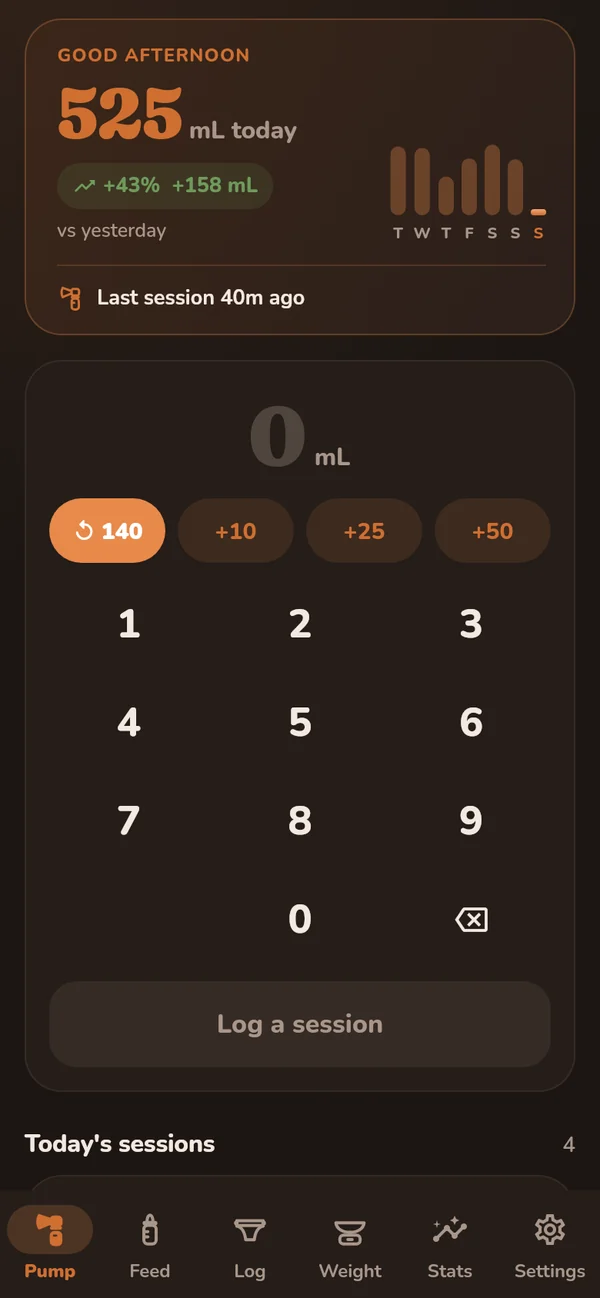
What Milkies doesn’t do: storage or freezer tracking, expiry dates, reminders, oz entry (it logs mL only), a nursing timer or breast side, or sleep tracking. It is a log, not a medical device, and it gives no medical advice.
Milkies logs every pumping session and every bottle in mL, on both parents’ phones, so you can see how much went in and how much came out. Free, no account, no ads.
Get MilkiesSources
- CDC: Breast Milk Storage and Preparation (reviewed 25 March 2026, updated 14 August 2026; adapted from ABM Clinical Protocol #8)
- NHS: Expressing and storing breast milk (page last reviewed 18 August 2026)
- NHS: Diarrhoea and vomiting (page last reviewed 21 December 2023)
Sources checked as of .