
General information, not medical advice. Your midwife, health visitor or paediatrician knows your baby. This page is not for babies born early, babies who are not gaining weight, babies with a medical condition, or babies on a specialist formula: follow your care team’s plan.
How many wet diapers are normal in the first week?
It depends on the day of life. The NHS says a baby is likely to have only 2 or 3 wet nappies in the first 48 hours. From day 5, it expects at least 6 heavy, wet nappies every 24 hours. The AAP gives the same marker a little later: 6 or more wet diapers a day by 5 to 7 days old. Neither page sets an exact count for days 3 and 4, so read those days as a rising trend rather than a target.
| Day of life | Wet diapers | Dirty diapers | What the poo looks like |
|---|---|---|---|
| Days 1–2 | 2–3 in the first 48 hours (NHS) | 1–2 a day (AAP) | Blackish and tarry (meconium) (AAP) |
| Days 3–4 | Rising; no set number in either source | At least 2 a day (AAP); at least 2 from day 4 (NHS) | Turning greenish to yellow (AAP); soft and yellow from day 4 (NHS) |
| Days 5–7 | 6 or more a day (AAP: by days 5–7; NHS: from day 5, heavy) | 3–4 or more a day (AAP); at least 2 (NHS) | Yellow and loose, with small curds (AAP) |
| After day 7, breastfed | 6 or more a day (AAP, NHS) | Fewer than 4 a day is an AAP warning sign; NHS: at least 2 a day for the first few weeks | Yellow and loose; still dark is a warning sign (AAP) |
| Formula-fed | Around 6 a day from a few days after birth (NHS) | At least 1 a day (NHS, AAP) | Pale yellow or yellowish brown within the first week (NHS); tan or yellow (AAP) |
What counts as a wet diaper?
The NHS describes a wet nappy as one that is wet with clear or pale yellow urine, or that feels heavy (NHS formula milk questions). Modern disposables soak up so much that a wet one can look dry. The NHS suggests a test: pour 2 to 4 tablespoons of water into an unused nappy so you know what “wet” feels like (NHS). In metric and US units, that works out like this:
| Tablespoons | mL | US fl oz |
|---|---|---|
| 2 tbsp | about 30 mL | about 1 oz |
| 3 tbsp | about 45 mL | about 1½ oz |
| 4 tbsp | about 60 mL | about 2 oz |
Pour it in, feel the weight, and compare it with the next diaper you change.
What should the urine look like?
By 5 to 7 days old, the AAP expects urine that is nearly colorless or pale yellow (AAP). In the first week you may see a pink or brick-red stain that looks like blood. The AAP says this is usually very concentrated urine, and that as long as the baby is wetting at least four diapers a day there is probably no cause for concern. If the staining lasts, ask your pediatrician. After that first week, real blood in the urine or a bloody spot on the diaper is never normal and should be reported (AAP, bowel movements and urination).
Urine output can also drop by half when a baby is ill or feverish, or when the weather is very hot, and the AAP says that can still be normal (AAP).
How many dirty diapers should a newborn have?
The first poos are meconium: thick and black or dark green (AAP). For a breastfed baby, the AAP describes 1 or 2 blackish stools on days 1 and 2, at least 2 greenish-to-yellow stools on days 3 and 4, and 3 to 4 or more yellow, loose stools with small curds by days 5 to 7 (AAP). The NHS puts it more simply: from the fourth day, at least 2 soft, yellow poos about the size of a £2 coin every day for the first few weeks (NHS).
Formula-fed babies tend to poo less often. The NHS says they should have at least 1 poo a day, pale yellow or yellowish brown within the first week (NHS), and the AAP gives the same minimum (AAP).
Does the pattern change after the first few weeks?
Yes, for poo more than for pee. The AAP notes that by three to six weeks, some breastfed babies poo only once a week and are still normal, and that green stools and occasional changes in color or texture are not unusual (AAP). The counts above are for the first weeks; after that, ask your health visitor or pediatrician what to expect.
Are diapers enough to tell if my baby is eating enough?
Not on their own. The NHS says weight gain and the number of wet and dirty nappies together tell you whether a formula-fed baby is getting enough (NHS), and lists how the baby feeds alongside nappies for breastfed babies (NHS). The AAP says a newborn should lose no more than 8% to 10% of birth weight in the first few days before gaining again (AAP), and lists being under birth weight at two weeks as a warning sign (AAP). Our guide on how to track baby weight gain covers the weigh-ins, and how much a newborn eats covers the amounts.
Why keep a written diaper log?
At 3am nobody remembers whether that was the fourth or fifth wet diaper since breakfast. The AAP suggests keeping a written record of wet diapers and bowel movements in the early days, and notes that many hospitals and lactation specialists hand out a diary for it (AAP). A log also helps when two people take turns: whoever changed the last diaper may be asleep when the question comes up. If you share night shifts, our guide to a feeding tracker for two parents covers how to split the logging.
How does Milkies count diapers?
On the Log tab, one tap on Diaper change records a diaper at that moment. The card at the top shows the time since the last diaper and how many diapers you have logged today, and below it a timeline of today’s diapers and doses shows the gap between each one. A mis-tap can be undone straight away, or swiped off today’s list later. If you pair a second phone, its diaper changes show up on yours too, and every diaper change is included when you export your data as CSV.
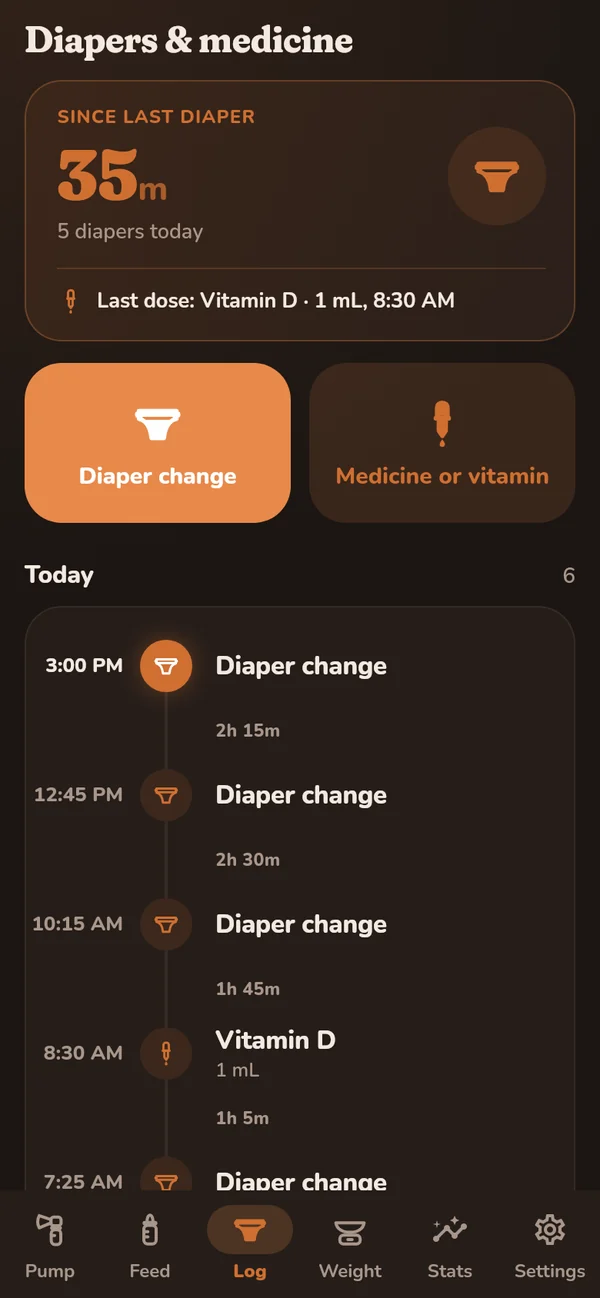
What Milkies doesn’t do: a diaper change is a time and nothing else. There is no wet, dirty or both option, no color or texture field, and no way to log a diaper at an earlier time, so tap when you change it. “Today” runs from midnight, not a rolling 24 hours. Only today’s diapers are on screen; earlier days are in the CSV export. Milkies does not warn you when the count is low and has no reminders. If you need to count wet and dirty diapers separately in the first week, a paper tally next to the changing mat works alongside the app’s total.
Milkies counts every diaper change in one tap and shows how long it has been since the last one. Free, no account, no ads.
Get MilkiesSources
- NHS: Breastfeeding: is my baby getting enough milk? (page last reviewed 30 April 2026)
- American Academy of Pediatrics (HealthyChildren.org): How to Tell if Your Breastfed Baby is Getting Enough Milk (last updated 13 January 2025)
- NHS: Formula milk: common questions (page last reviewed 8 September 2023)
- American Academy of Pediatrics (HealthyChildren.org): Baby’s First Days: Bowel Movements & Urination (last updated 14 November 2024)
- American Academy of Pediatrics (HealthyChildren.org): Warning Signs of Breastfeeding Problems (last updated 25 March 2024)
- NHS: Dehydration (page last reviewed 1 May 2026)
Sources checked as of .