
General information, not medical advice. Your midwife, health visitor or paediatrician knows your baby. This page is not for babies born early, babies who are not gaining weight, babies with a medical condition, or babies on a specialist formula: follow your care team’s plan.
How often should you pump when exclusively pumping?
It depends on the stage. Early on, La Leche League GB suggests ideally 8–12 sessions in 24 hours for the first three to four months, with gaps of no more than two to three hours and one longer stretch of four to five hours at night. KellyMom’s supply page says at least eight sessions per 24 hours, and ten is better, until supply is well established, with at least one at night and no gap longer than 5–6 hours in the first few months. The CDC says to pump as often as your baby drinks breast milk.
| Stage | Sessions per 24 h | Gaps and nights | Daily milk (mL) | Daily milk (oz) |
|---|---|---|---|---|
| Until supply is established, the first few months (KellyMom) | At least 8, 10 is better (KellyMom) | At least one session at night; no gap over 5–6 h (KellyMom) | Aim of 750–800 mL by days 7–10 (KellyMom) | 25–27 oz |
| Birth to about 3–4 months (La Leche League GB) | 8–12 (La Leche League GB) | Gaps of 2–3 h, one longer 4–5 h stretch at night, a session ideally between 2am and 5am (La Leche League GB) | Babies 1–6 months take 570–900 mL, about 750 on average (KellyMom); 750–1035 mL (La Leche League GB) | 19–30 oz, about 25 on average; 25–35 oz |
| Once supply is established (usually 3–4 months) | Reduced slowly, one session at a time (La Leche League GB) | Lengthen the night gaps first, keep one night session, then after 3–4 weeks consider dropping one daytime session (La Leche League GB) | Same intake range as above | Same as above |
The two sources disagree on daily intake: KellyMom’s range for babies aged one to six months is 570–900 mL (19–30 oz), with 750 mL (25 oz) as the average, while La Leche League GB gives 750–1035 mL a day for the same ages. Both are averages across many babies, not a number any one baby has to hit. For pumped amounts by day and by session, see how much milk you might pump.
Why do the first weeks matter so much?
Both sources treat the first months as the time supply is built. KellyMom’s supply page says “until supply is well established, it is important to get at least eight good nursing and/or pumping sessions per 24 hours”, and gives an aim of 750–800 mL (25–27 oz) a day by days 7–10 after birth. La Leche League GB says to start expressing colostrum within six hours of birth if possible, and points out that a newborn would feed 8–12 times in 24 hours, so expressing just as often copies what a feeding baby does.
The sessions don’t have to be evenly spaced. La Leche League GB says you don’t always need to pump at regular intervals; the point is to avoid long gaps.
Do you have to pump at night?
In the early months, both sources say yes, at least once. KellyMom’s supply page says to pump “at least once during the night in the first few months”; its exclusive pumping page, mostly parents’ stories, suggests twice at night in the first couple of weeks and gives a floor of 7 sessions a day. La Leche League GB asks for at least one overnight session, ideally between 2am and 5am, when prolactin levels are highest, and allows one longer stretch of four to five hours at night if your supply holds up. If two of you are up at night, a plan for splitting night feeds can leave the pumping parent free to pump while the other gives the bottle.
How long should each pumping session be?
There is no single answer. La Leche League GB notes that some experts suggest about 15–20 minutes, while others say a fixed time isn’t helpful because some parents take up to 45 minutes. Its practical rule is to pump until the milk stops spraying, then for about five minutes more. The KellyMom exclusive pumping page gives a similar picture: about 20 minutes, at least 15, and about five minutes past the point where milk stops. As you drop sessions, La Leche League GB says each one may need to be longer to get the same amount.
When and how do you drop pumping sessions?
La Leche League GB says supply is usually established between three and four months, and that from then you may decide to slowly reduce your daily sessions, or keep your schedule as it is if you plan to pump long term. Its suggested order:
- Lengthen the gaps between your overnight sessions, but keep expressing once at night.
- After about three to four weeks, consider dropping one daytime session.
- Shift your other sessions so you don’t leave one big gap.
It warns against rushing, because sudden long gaps can make blocked ducts or mastitis more likely, and suggests that a shorter session is better than a missed one. It also suggests keeping a record of your daily output while you cut back, so you can see what each change does.
What does a pumping schedule look like in numbers?
Spreading sessions over 24 hours is simple arithmetic: 8 sessions averages one every 3 hours, 10 sessions one every 2.4 hours, and 12 one every 2 hours. To estimate how much your baby might take per feed, KellyMom divides the daily average by the number of feeds: 750 mL over 8 feeds is about 94 mL (3.2 oz). Pump output per session varies more than this. Your own numbers will differ, and the trend over days tells you more than any single session.
How can you track an exclusive pumping schedule?
La Leche League GB’s suggestion to keep a record of daily output is the part Milkies is built for. Each pumping session in Milkies is an amount in mL, stamped with the time you tap Log. You can correct the amount by long-pressing the session while it is still in today’s list, on the same day; the time stays as logged, so it helps to log right after you finish.
- Pump tab: millilitres pumped today, today against yesterday as a percentage, the last seven days as bars, today’s sessions in a list with how many you have logged, and how long since your last session, which is the number to watch if you are keeping gaps short.
- Stats, Pumping: total so far, daily average, biggest day and biggest week, today against yesterday, this week against the same days of last week, a daily chart (7 days, 30 days or all) with a dashed average line, and the last 12 weeks as bars.
- Patterns: your average session in mL, your current streak (days in a row with at least one session) and your busiest time (the hour you pump most often).
If you are dropping a session, the daily chart and the week-against-week line show whether your total held steady.
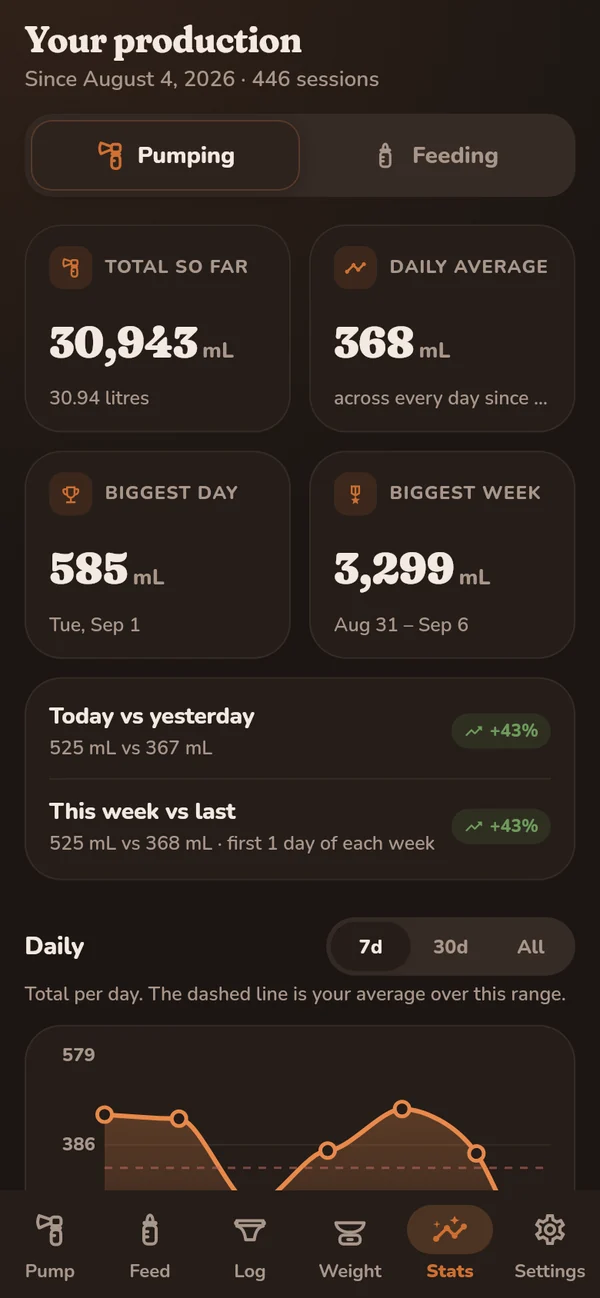
What Milkies doesn’t do: it has no pumping timer and no session length, no left or right breast, no reminders or alarms for the next session, and no sessions-per-day figure in Stats (the Pump tab shows how many sessions you have logged today). It doesn’t warn you about long gaps or low output, it logs mL only (no oz), and it doesn’t track stored milk, so for fridge and freezer times see CDC and NHS storage guidelines.
Milkies logs every pumping session in mL and charts your daily and weekly totals and shows your streak and busiest hour, so you can see how a schedule change lands. Free, no account, no ads.
Get MilkiesSources
- La Leche League GB: Exclusively Expressing Breastmilk for Your Baby (written May 2020)
- KellyMom: Establishing and maintaining milk supply when baby is not breastfeeding (updated 22 August 2026)
- CDC: Pumping Breast Milk (dated 24 February 2026)
- KellyMom: Exclusive Pumping (updated 22 August 2026)
- NHS: Mastitis (last reviewed 17 March 2023)
- AAP (HealthyChildren.org): How to Tell if Your Breastfed Baby is Getting Enough Milk (updated 13 January 2025)
Sources checked as of .